Arizona Pandemic Unemployment Assistance

Case Study: Arizona Pandemic Unemployment Assistance
How a Public-Private Partnership Provided Benefits to Eligible Individuals and Saved Billions for One State
IDMe and the Arizona Department of Economic Security (DES) Partnered to Ensure Eligible Individuals Received Pandemic Unemployment Assistance (PUA) while Protecting Taxpayers and Combating Fraud
With New Benefits Come New Challenges
The economic disruption from the COVID-19 pandemic caused an enormous spike in unemployment insurance claims. This historic increase made it difficult for workforce agencies to distribute much-needed benefits to unemployed workers. In March 2020, the Coronavirus Aid, Relief, and Economic Security (CARES) Act authorized the Pandemic Unemployment Assistance (PUA) program to get relief to self-employed, gig, and other independent contract workers quickly, who otherwise would not traditionally be eligible for Unemployment Assistance. PUA program applicants were allowed to self-report their employment status. To apply for PUA, individuals only needed a name, date of birth, address, and Social Security Number and to self-certify as being unemployed due to COVID — information that was readily available on the dark web, in part, as a result of previous corporate data breaches.
“IDMe helped DES save the State of Arizona over $75 billion in payouts on fraudulent PUA claims”
State agencies implemented new processes and portals to distribute PUA benefits. The complexity and enticement to fraudsters were made even greater with the value of the supplementary Federal Pandemic Unemployment Compensation (FPUC). As early as May 2020, a Nigerian fraud ring dubbed “Scattered Canary” reportedly siphoned hundreds of millions of dollars from the state of Washington before the coordinated attack was identified. The Federal Trade Commission (FTC) found a 2,918% increase in identity theft related to government benefits in its 2020 Consumer Sentinel Network report.
As fraudsters began to target new states, the Arizona Department of Economic Security (DES) saw a massive rise in claimants. There were 77,063 initial PUA applications filed during the week ending May 16, 2020. That weekly number had risen to 266,674 by July 25. Initial applications for PUA peaked at 570,409 for the week ending October 10, according to the Arizona Unemployment Insurance Dashboard.
The surge in fraudulent claims made an already difficult operational task exponentially harder.
Protecting Access to Critical Support
The DES Unemployment Insurance team knew they had to deliver unemployment benefits to a record number of applicants and that speed and ease of use were critical. Given the unique challenges of the pandemic, DES prioritized getting benefits to eligible individuals. With the massive influx of fraudulent claims, that goal became increasingly challenging. In order to maintain critical services and combat fraud simultaneously, DES cultivated key public-private partnerships.
DES partnered with Google’s fraud analytics team to analyze the millions of claims received. Google’s team estimated that the vast majority of the claims were fraud, many of them due to identity theft.
Given these results, DES set out to find a solution that could accurately identify legitimate applicants while blocking fraudulent claims. They also understood that if Arizona was under attack, then every other state was likely getting attacked as well. They reached out to other states to seek advice and share best practices.
IDMe Partners with States to Combat Fraud
The DES team reached out to the National Association of State Workforce Agencies (NASWA) to learn more about identity verification options. NASWA had conducted market research on solutions that aligned to the National Institute of Standards and Technology (NIST) standards for consumer authentication to government agencies – NIST Identity Assurance Level (IAL) 2. During an August 2020 call, DES learned about IDMe, a company certified against the NIST IAL2 standards, that provided digital identity access to federal and state agencies while protecting them from fraud.
DES identified key areas that set IDMe apart from the competition:
- Unsupervised Remote: a NIST IAL2 capability that enables people to verify their identity through software in just a few minutes to verify identity and to process claims.
- Supervised Remote: a NIST IAL2 capability that enables people whose identity doesn’t match in records to verify their identity through a video chat session with a trained agent.
- State References: early adopters like Florida, Georgia, and Nevada saw massive reductions in fraudulent claims along with a high degree of insight into fraud patterns.
By September 2020, a number of states had implemented IDMe, including Florida, Georgia, and Nevada. IDMe had already successfully verified tens of thousands of legitimate claimants while also greatly diminishing fraud.
For example, Nevada was seeing more PUA applications than people that existed in the workforce. IDMe was implemented for existing PUA claims in August 2020 and made an immediate impact, dropping the number of continued claims from 128,190 in the beginning of August to 99,397 in the beginning of September, a decrease of 22%.
DES saw that in addition to achieving results, IDMe was aligned with the agency:
- On a mission to help people. Both DES and IDMe understood that the PUA benefits they were protecting were critical for those who otherwise could not afford basic essentials.
- With a solution to help everyone. DES turned to IDMe to provide verification for applicants in unique circumstances, such as those with limited credit records.
A Pilot Program Fueled by Passion
In September of 2020, IDMe and DES began working together to protect Arizona’s residents and help identify legitimate claimants in need of help. For the DES team, this public-private partnership could not have come at a better time. IDMe arrived with a secure, easy-to-navigate platform and a personal approach to digital identity verification that never sacrificed human connection or compassion.
Rather than charging clients based on the number of fraudulent claims identified, IDMe builds its pricing model around successfully verified applicants — a major factor in the DES’s decision to work with IDMe.
-68.3%
“On December 4th, DES deployed IDMe to verify all existing PUA claimants; within one week, claims went down by 68.3%”
State agencies implemented new processes and portals to distribute PUA benefits. The complexity and enticement to fraudsters were made even greater with the value of the supplementary Federal Pandemic Unemployment Compensation (FPUC). As early as May 2020, a Nigerian fraud ring dubbed “Scattered Canary” reportedly siphoned hundreds of millions of dollars from the state of Washington before the coordinated attack was identified. The Federal Trade Commission (FTC) found a 2,918% increase in identity theft related to government benefits in its 2020 Consumer Sentinel Network report.
As fraudsters began to target new states, the Arizona Department of Economic Security (DES) saw a massive rise in claimants. There were 77,063 initial PUA applications filed during the week ending May 16, 2020. That weekly number had risen to 266,674 by July 25. Initial applications for PUA peaked at 570,409 for the week ending October 10, according to the Arizona Unemployment Insurance Dashboard.
The surge in fraudulent claims made an already difficult operational task exponentially harder.
Immediate Results, Widespread Implementation
By October, the results of the pilot program were clear. IDMe went live, starting with verification of high-risk claims on September 3, 2020 and expanded to all new PUA claims on October 29, 2020. Data from the Arizona Unemployment Insurance dashboard shows the effects:
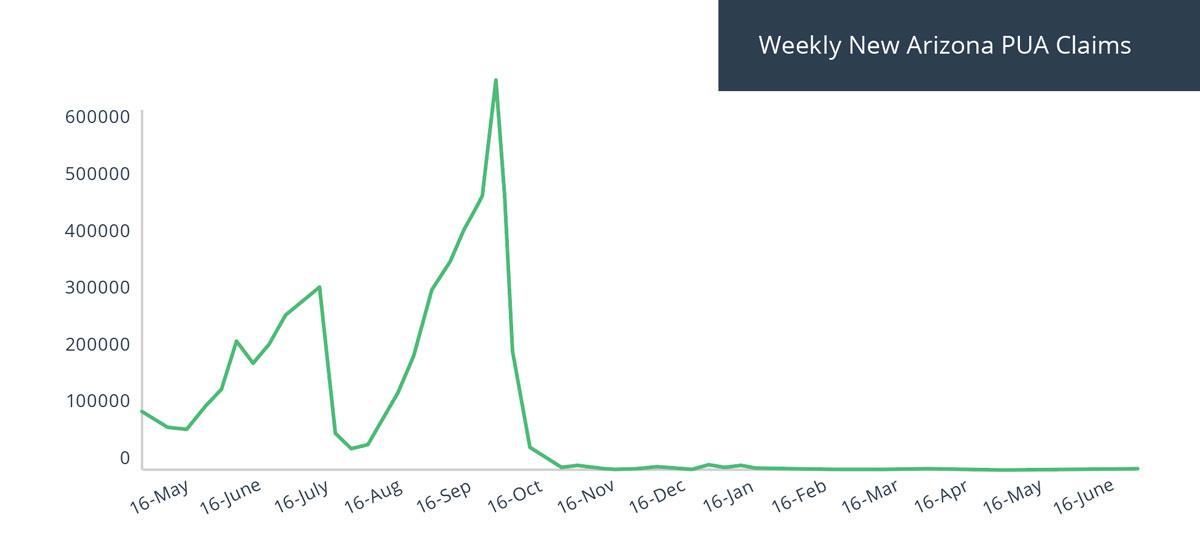
IDMe contributed to a dramatic reduction in the number of claims, from a record high of nearly 570,400 claims filed the week ending October 10 to just 6,700 the week ending November 14. This represents a 98.8% decrease in new claims filed, many of which were fraudulent.
On December 4th, DES deployed IDMe to verify all existing PUA claimants; within one week, claims went down by 68.3%.
- PUA Continued Claims week ending 12/5: 268,556
- PUA Continued Claims week ending 12/12: 85,174
For the agency, this was more than a relief; it ensured that they would be able to continue to fulfill their mission despite organized attacks from international fraud rings. Using IDMe allowed DES staff to find the legitimate claimants and deliver benefits to them
in a timely manner.
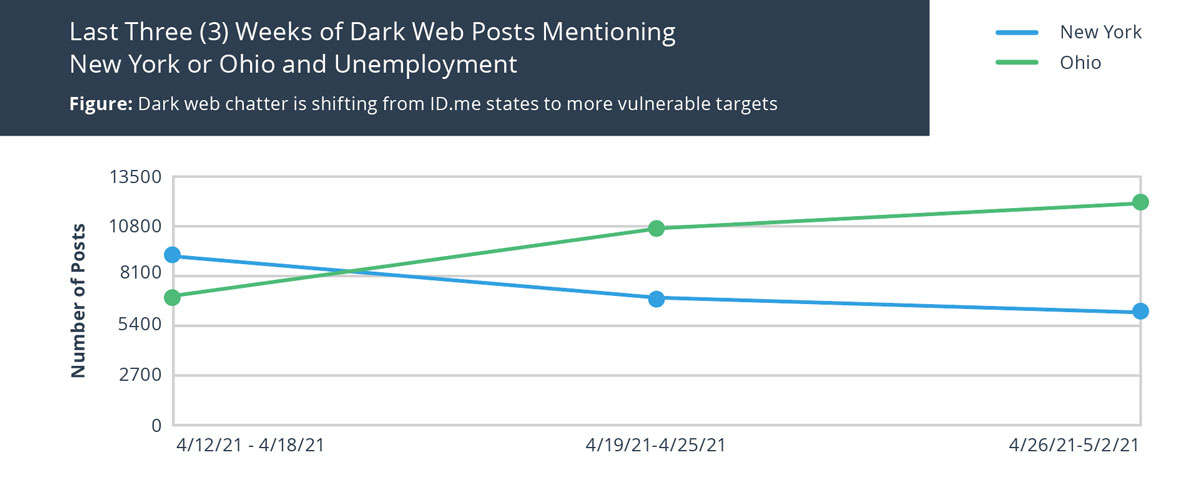
As soon as Arizona implemented IDMe’s protection, criminals took note. Dark web chatter indicated that fraudsters needed to go elsewhere. In December 2020, a dark web poster said, “Do you not understand PUA is dead, all them states switching over to IDMe.” Time and time again, a pattern emerged: a state would contract with IDMe, and a few weeks later criminals would migrate away from IDMe customers and inundate less protected targets. Ohio saw its weekly average of PUA claims more than double from 15,176 in September to a weekly average of 36,593 in October according to the Department of Labor’s Weekly Pandemic Claims Data. Dark web chatter tied to New York State Department of Labor fraud decreased by 35% after IDMe began protecting new claims, while dark web chatter tied to Ohio increased by 76% during the same time period. A May 2021 post made it clear, “Ohio method with no IDMe. Try my sauce and smile.” (Sauce is a how-to guide for fraud). Per the
last intercept, the trend represents a pure transfer of risk from New York to Ohio.
+80%
“To date, 27 states in the U.S. have contracted with IDMe, which now covers more than 80% of the population”
To date, 27 states in the U.S. have contracted with IDMe, which now covers more than 80% of the population — and all of this occurred in the span of 10 months. Less than a year into their contract, Director Wisehart said, “I would recommend IDMe to any state agency — and I already have. It has given us the confidence that we are assisting individuals who really need it, and I know every state, and their taxpayers, would benefit from this peace of mind.”
At the core of Director Wisehart’s confidence is the fact that IDMe helped DES save the State of Arizona over $75 billion in payouts on fraudulent PUA claims — and that might be a conservative estimate. Director Wisehart pointed to the spike in claims in summer 2020 and said that, if claims had continued on that trajectory unchecked, Arizona would likely have seen well over $75 billion in fraudulent claims. According to Director Wisehart, IDMe was the key to stopping that momentum and safeguarding taxpayer resources. “It’s all right there in the data,” CEO Blake Hall said. “States were getting overrun, and we were in a position to help.”
Request a Demo of IDMe
See Our Identity Verification Technology in Action
Schedule a consultation with one of our experts to see a demo of IDMe and discuss how we can help reduce fraud and take friction out of your customer experience.
IDMe helps hundreds of companies solve their toughest identity challenges for applications like:
- Government citizen portals
- Healthcare eRx & patient portals
- Bank account opening, KYC and e-commerce sites
- and dozens more we can’t wait to tell you about.